



Table of contents
- What Is an Ethernet Private Line
- How Does Ethernet Private Line Work
- UNI, EVC, CPE explained in plain language
- What “point-to-point” really means
- How traffic stays separate from public internet traffic
- What Problems Does EPL Solve
- Key Benefits of Ethernet Private Line
- Common Ethernet Private Line Use Cases
- Ethernet Private Line vs MPLS
- Ethernet Private Line vs Internet VPN / DIA
- Ethernet Private Line vs IPLC / IEPL
- Ethernet Private Line vs EoMPLS / Cloud Connect
- When EPL Is the Right Choice — and When It Isn’t
- Why Businesses Choose IPTP Networks for EPL and Global Connectivity
If your business needs to connect an office, a data center, disaster recovery site, or international location without relying on the public internet, you have probably come across the term Ethernet Private Line. Public internet connections often introduce unpredictable latency, packet loss, and security risks that become critical when transmitting sensitive financial data, running real-time applications, or synchronising databases between two key sites.
Ethernet Private Line (EPL) gives you a dedicated, point-to-point Ethernet circuit that completely bypasses the public internet. This article explains how EPL works, what makes it different from other connectivity options like MPLS, DIA, IPLC, EoMPLS, or Cloud Connect, and in which scenarios it becomes the right choice for your network.
What Is an Ethernet Private Line
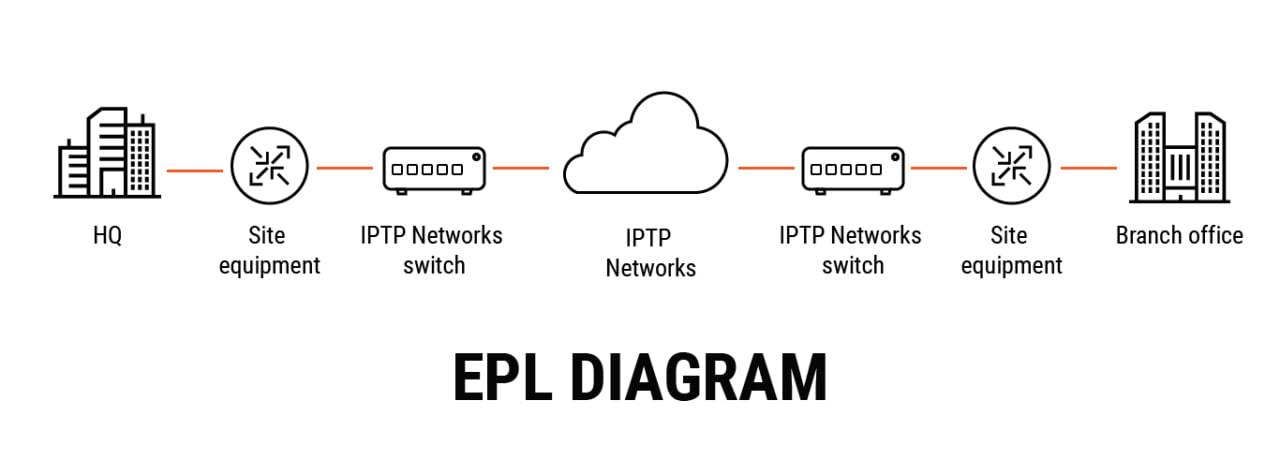
Ethernet Private Line (EPL) is a dedicated point-to-point Ethernet service that connects two customer locations. The connection is private, meaning no other traffic shares the link. It is delivered over a service provider’s network and behaves like a direct cable between the two sites.
EPL is often called an E-Line service, following the MEF 6.1 definition as a point-to-point service between two UNIs. It is used to connect an office to a data center, a data center to a backup site, or any two locations that need a reliable, high-performance Layer 2 link. The customer sees a standard Ethernet interface at each end, making it easy to integrate with existing switches and routers.
How Does Ethernet Private Line Work
EPL uses a provider’s Ethernet infrastructure to create a virtual connection between two customer-designated ports.
UNI, EVC, CPE explained in plain language
UNI (User-Network Interface): This is the physical port on the customer’s equipment where the EPL handover happens. It is typically an Ethernet port with speeds from 10 Mbps up to 10 Gbps or more.
EVC (Ethernet Virtual Connection): A logical association between two UNIs. The EVC carries all traffic between the two sites and ensures that frames are delivered in order, without any other customer’s traffic interfering.
CPE (Customer Premises Equipment): The router or switch at the customer’s site that connects to the provider’s network. In many cases, the provider supplies or configures this device.
What “point-to-point” really means
A point-to-point connection is strictly between two locations. Unlike a multipoint service (such as a VPN or MPLS Layer 3 VPN), EPL does not allow communication with any other site unless you provision a separate circuit. This simplicity gives you predictable performance because the entire bandwidth is reserved for your traffic.
How traffic stays separate from public internet traffic
The provider builds the EPL over a private transport network, often using MPLS or optical wavelengths. Your data never leaves the provider’s controlled infrastructure, reducing exposure to DDoS attacks, interception, and best-effort congestion.
What Problems Does EPL Solve
EPL directly addresses several common issues that arise when using the public internet for business-critical links:
- Unstable public internet paths: Your traffic may take different routes depending on BGP policies and congestion, leading to variable latency and jitter. EPL follows a fixed path.
- Congestion and inconsistent performance: Internet bandwidth is shared. During peak hours, your throughput can drop dramatically. EPL gives you dedicated bandwidth that does not fluctuate.
- Security and compliance concerns: Regulations such as GDPR, HIPAA, or PCI-DSS may require that certain data never traverses the public internet. EPL provides a private, auditable path.
- Critical traffic between sites: Real-time database replication, video conferencing, large file transfers, and backup operations need stable, high-throughput links. EPL delivers SLA-backed reliability.
Key Benefits of Ethernet Private Line
Dedicated bandwidth: The full capacity of the circuit is reserved for your traffic, with no contention from other users.
Predictable latency and performance: Because the path is fixed and bandwidth is guaranteed, you can rely on consistent round-trip times and throughput.
SLA-backed private connectivity: Service Level Agreements cover uptime, latency, packet loss, and repair times, giving you legal recourse if performance degrades.
VLAN / Layer 2 transparency: You can send any Layer 2 traffic, including VLAN tags, spanning tree, and non-IP protocols, exactly as if the two sites were connected by a single switch.
Scalability by bandwidth tiers: You can start with a lower speed (e.g., 10 Mbps) and increase in increments (100 Mbps, 1 Gbps, 10 Gbps) without changing the underlying infrastructure.
Common Ethernet Private Line Use Cases
- Office to data center: Connect a corporate headquarters to a primary or colocation data center for centralised applications and storage (office to data center connectivity).
- Data center to disaster recovery site: Replicate data synchronously or asynchronously to a backup location with consistent low latency (backup and disaster recovery connectivity).
- Backup and restore traffic: Move large backup sets quickly and reliably without saturating your internet link (dedicated bandwidth between two locations).
- Voice and video between locations: Maintain high-quality real-time communications free from jitter and packet loss (low latency connectivity for critical applications).
- Media file transfer: Send uncompressed video, audio, or large design files between production studios and editing facilities.
- Financial, healthcare, or campus connectivity: Connect trading floors, hospital systems, or university campuses where privacy and performance are paramount (secure site to site connectivity).
Ethernet Private Line vs MPLS
MPLS (Multiprotocol Label Switching) is a private network service that connects multiple sites in a mesh or hub-and-spoke topology. It supports any-to-any communication and allows you to assign different classes of service to different types of traffic. Learn more in our MPLS guide.
EPL is strictly point-to-point. If you need to connect exactly two locations — for example, a headquarters and a single data center — EPL is the simplest and most predictable solution (ethernet private line vs mpls). If you have three or more sites that all need to communicate with each other, MPLS VPN or a Layer 3 VPN may be more cost-effective and easier to manage. For critical point-to-point links within a larger MPLS network, many companies still use EPL as the underlying transport for its guaranteed performance.
Ethernet Private Line vs Internet VPN / DIA
Direct Internet Access (DIA) provides a business-grade internet connection with a public IP address. You can build an IPsec VPN tunnel over that internet connection to connect two sites. This approach is inexpensive and works for many non-critical applications. See IP Transit vs DIA or Remote DIA/VPN.
The trade-off is that you have no control over the internet path. Latency spikes, packet loss, and congestion are common. For applications that are sensitive to jitter (like voice or video) or that require predictable throughput (like database replication), an internet VPN is often insufficient (ethernet private line vs DIA). EPL gives you deterministic performance and stronger security because the traffic never leaves the provider’s private network (private connection between office and data center).
Ethernet Private Line vs IPLC / IEPL
IPLC (International Private Leased Circuit) is a dedicated point-to-point connection that historically uses SONET/SDH or dedicated wavelengths. IEPL (International Ethernet Private Line) is the Ethernet-native equivalent. Both are designed for international links between countries. What is IPLC?
In practice, for many providers, EPL and IPLC/IEPL are similar for international connectivity (international ethernet private line). The main difference is the underlying technology and pricing. EPL is typically
Ethernet-native and may offer more flexible bandwidth increments (global ethernet private line). IPLC may be necessary for legacy interfaces or very long distances where the provider’s network is based on optical transport rather than Ethernet switching. When evaluating international options, focus on the SLA, latency, and supported speeds rather than the name.
Ethernet Private Line vs EoMPLS / Cloud Connect
EoMPLS (Ethernet over MPLS) emulates a transparent Layer 2 circuit over MPLS, similar to EPL but often multipoint-capable. What is EoMPLS? EPL is simpler for strict point-to-point with full Ethernet transparency. Cloud Connect provides direct, private links to AWS/Azure/Google Cloud edges, ideal for hybrid cloud but less flexible for non-cloud site-to-site (Direct Cloud Connections). Choose EPL for pure site-to-site without cloud dependency; otherwise, mix with these for hybrid setups.
When EPL Is the Right Choice — and When It Isn’t
EPL is the right choice when:
- You need to connect exactly two locations (point-to-point) (point to point ethernet service).
- Your traffic is sensitive to latency, jitter, or packet loss (low latency connectivity for critical applications).
- You require dedicated, guaranteed bandwidth (dedicated ethernet connection between sites).
- You want Layer 2 transparency (VLANs, non-IP protocols) (vlan transparent layer 2 service).
- You need an SLA with measurable performance metrics (ethernet leased line for business).
EPL may not be the best choice when:
- You have three or more sites that need full mesh connectivity (consider MPLS or SD-WAN).
- Your budget is very tight and performance requirements are low (consider DIA with VPN).
- You only need occasional, low-volume data transfer (cloud-based backup over internet may suffice).
- You want to integrate with cloud providers directly (Cloud Connect services might be simpler and cheaper) — instead, explore EoMPLS Pseudowire.
Why Businesses Choose IPTP Networks for EPL and Global Connectivity
IPTP Networks operates a global private backbone with more than 228 Points of Presence (PoPs) in key commercial hubs across Europe, the Americas, Asia, and the Middle East Connectivity Services. This infrastructure allows us to deliver EPL connections with low latency Low Latency Routes and high reliability, even for international routes (epl provider for enterprises).
Our engineers do not simply sell a circuit; they design a solution based on your specific requirements using tools like Best Path. In addition, we offer adjacent services such as MPLS, IPLC, EoMPLS, Direct Internet Access, and cloud connectivity, so we can build a hybrid architecture that fits your exact needs.
Need Help Choosing Between EPL, MPLS, IPLC, or DIA?
Selecting the right connectivity service depends on your number of sites, traffic patterns, budget, and performance requirements (ethernet private line quote). IPTP Networks engineers are available to review your situation, propose a tailored scheme, or calculate costs.
Contact us today for a free consultation, network design, or quote.